The Nobel Eightfold Path: Sīla, Samādhi & Paññā
I have added the Wikipedia information as is, with all the citations and hyperlinks. Sole reason for this is to avoid pushing my biases or interpretations of The Nobel Eightfold Path.
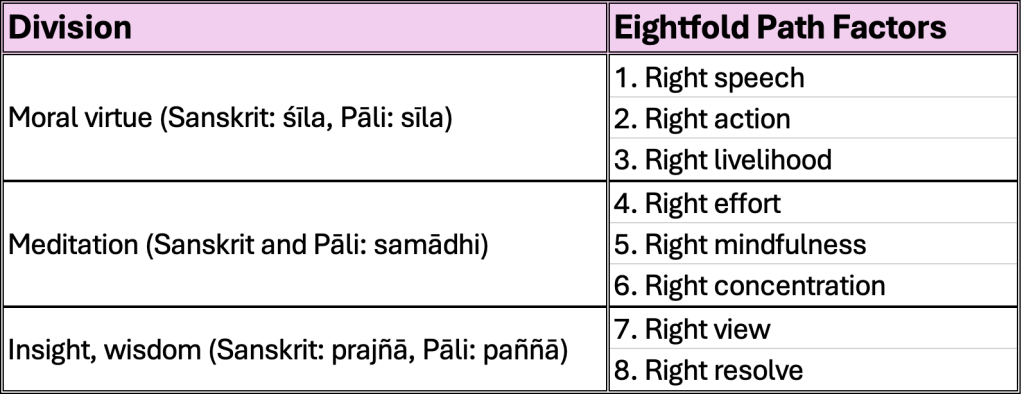

Moral virtue (Sanskrit: śīla, Pāli: sīla)
1. Right Speech: no lying, no abusive speech, no divisive speech, no idle chatter.[40][41]
2. Right action: no killing or injuring, no taking what is not given, no sexual misconduct, no material desires.
3. Right livelihood: no trading in weapons, living beings, meat, liquor, or poisons.

Meditation (Sanskrit and Pāli: samādhi)
4. Right effort: preventing the arising of unwholesome states, and generating wholesome states, the bojjhaṅgā (Seven Factors of Awakening). This includes indriya-samvara, “guarding the sense-doors”, restraint of the sense faculties.[42][43]
5. Right mindfulness: a quality that guards or watches over the mind;[44] the stronger it becomes, the weaker unwholesome states of mind become, weakening their power “to take over and dominate thought, word and deed.”[45][note 2] In the vipassana movement, sati is interpreted as “bare attention”: never be absent minded, being conscious of what one is doing; this encourages the awareness of the impermanence of body, feeling and mind, as well as to experience the five aggregates (skandhas), the five hindrances, the four True Realities and seven factors of awakening.[43]
6. Right concentration: practicing four stages of dhyāna (“meditation”), which includes samadhi proper in the second stage, and reinforces the development of the bojjhaṅgā, culminating into upekkhā (equanimity) and mindfulness.[47] In the Theravada tradition and the vipassana movement, this is interpreted as ekaggata, concentration or one-pointedness of the mind, and supplemented with vipassana meditation, which aims at insight.

Insight, wisdom (Sanskrit: prajñā, Pāli: paññā)
7. Right view: our actions have consequences, death is not the end, and our actions and beliefs have consequences after death. The Buddha followed and taught a successful path out of this world and the other world (heaven and underworld/hell).[33][34][35][web 1] Later on, right view came to explicitly include karma and rebirth, and the importance of the Four Noble Truths, when “insight” became central to Buddhist soteriology, especially in Theravada Buddhism.[36][37]
8. Right resolve: also known as “right thought”, “right aspiration”, or “right motivation”.[38] In this factor, the practitioner resolves to strive toward non-violence (ahimsa) and avoid violent and hateful conduct.[37] It also includes the resolve to leave home,

 The Happy Breath
Leave a comment